

Some connections between countries arise through trade. Others through war. Some through science.
All three existed between Germany and Cyprus—and they begin earlier than you might think.
An emperor makes Cyprus a fiefdom
At the end of the 12th century, long before Northern Cyprus became a place of longing, the island was already part of German imperial policy.
In 1195, King Amalrich of Lusignan paid homage to Holy Roman Emperor Henry VI at the imperial diets of Gelnhausen and Worms. Cyprus thus formally became a fief of the Holy Roman Empire.
Two years later, in September 1197, the imperial chancellor Konrad von Querfurt, Bishop of Hildesheim, traveled specifically to Nicosia—and crowned Amalrich king of Cyprus in the cathedral there. In the name of the emperor.
Shortly thereafter, in March 1198, the Teutonic Order was founded in Acre. Konrad von Querfurt was present at its founding. Not long after, the Order already had its own branch in Nicosia.
An island in the eastern Mediterranean, administered, crowned, and visited on behalf of German emperors and clergy.
A Second Emperor, a Civil War
A generation later, another member of the House of Staufer laid claim to the island: Frederick II.
In 1225, he married Isabella II of Jerusalem, thereby also claiming guardianship over Henry I, King of Cyprus, who was still a minor.
In 1228, on his way to his crusade to the Holy Land, he stopped in Cyprus to personally enforce this claim. What followed was not a diplomatic success, but a civil war that lasted for years—the Lombard War, fought between imperial governors and the local nobility led by the Ibelin family.
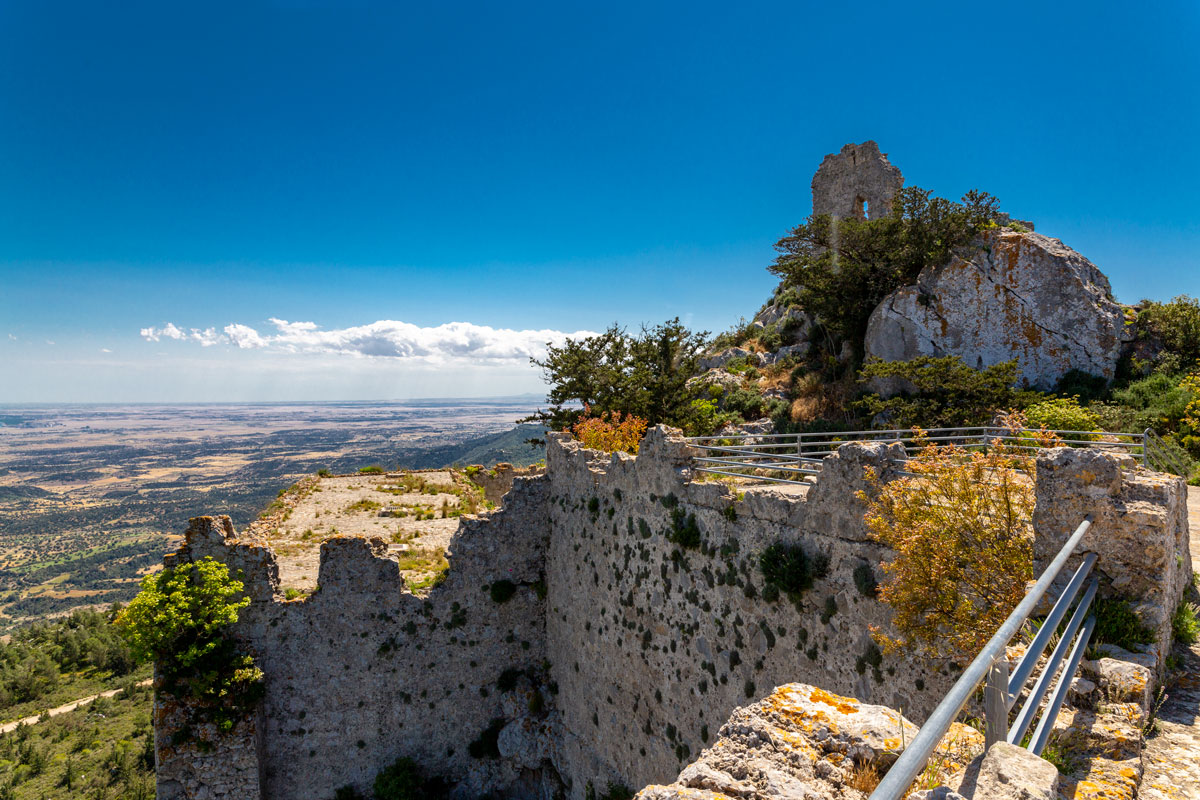
In July 1229, the imperial forces were defeated in the decisive battle outside the gates of Nicosia and retreated to three castles: Kyrenia, St. Hilarion, and Kantara. After months of siege—at St. Hilarion, the besieged are said to have ultimately slaughtered their own horses—all three fell back into the hands of the Ibelins in 1230.
The final decision was made on June 15, 1232, at Agridi, in the mountainous region behind Kyrenia: the largest battle in the entire history of the Crusades between Christians. The Ibelins emerged victorious. By 1233, imperial rule in Cyprus was definitively a thing of the past.
A conflict sparked by a German emperor, fought on Cypriot soil, and decided in the mountains of Kyrenia.
A Title That Lives On
The Staufer dynasty's history in Cyprus did not end in 1233—it left a legacy that shaped the island for centuries.
In 1268, Konradin, the last Hohenstaufen and grandson of Frederick II, was executed in Naples. With him, the Hohenstaufen line came to an end—but the title “King of Jerusalem,” which Frederick II had once held, passed through Hugh III to the kings of Cyprus.
From then on, following their actual coronation in Nicosia, Cyprus’s rulers also had themselves crowned “Kings of Jerusalem” at St. Nicholas Cathedral in Famagusta—a practice documented, among others, for Peter II in 1372. A title that was once held by German emperors and later carried on by Cypriot kings.
An archaeologist discovers ancient Cyprus
Six and a half centuries after Henry VI, another German returned—this time not with an army, but with an excavator.
Max Ohnefalsch-Richter, born in 1850 in Sohland, Saxony, arrived in Cyprus in 1878—the same year the island became a British protectorate. He began his career as a journalist. Starting in 1880, he conducted excavations on behalf of the British Museum and the British colonial administration, including at Salamis near Famagusta, and became one of the most active excavators of his time.
His magnum opus, *Cyprus, the Bible, and Homer*, was published in Berlin in 1893. Today, his collection of Cypriot antiquities ranks among the most significant holdings of the Berlin Museum of Prehistory and Early History, alongside Heinrich Schliemann’s Trojan collections.
Without him, our current understanding of ancient Cyprus would be very different.
A bond that continues to grow to this day
From Henry VI to Frederick II to Ohnefalsch-Richter—German-Cypriot history has never been a marginal chapter, but has repeatedly been part of broader developments: politically in the Middle Ages, and academically in the 19th century.
Today, this connection continues in different ways. Germany is one of the island’s most important partners in tourism; more and more German-speaking residents are making a new home on the north and east coasts; and interest in Cyprus as a place to live and invest is growing noticeably.
It is no coincidence, but a continuation. What began with emperors and chancellors and was carried on by a researcher lives on today in the people who consciously choose this island.
An emperor who ruled over the island. A explorer who introduced it to the world. And today: people who are making it their second home.