

Mid-November 2025, late afternoon, calm waters off Esentepe.
Then the water begins to swirl.
What DHA cameras captured at that moment quickly went viral on social media: a slender, spinning column of water rising up into the clouds—a waterspout, right off the coast of Girne.
The Moment Before Esentepe
For a few minutes, the natural spectacle caused a stir along the coast. Residents and vacationers watched the whirlpool from the boardwalk.
The waterspout never moved toward land. No damage, no injuries. Just a few particularly impressive minutes—and a video showing that this natural phenomenon is no longer a rarity off the coast of Northern Cyprus.
Not a new phenomenon, but a more common one
Waterspouts are not uncommon in the eastern Mediterranean. Historical data indicate that, on average, there are about three such events per year in the Cyprus region—mostly in late summer and early fall, when the sea is still warm but the air above it is already cooler. It is precisely this temperature difference that promotes the formation of the characteristic, rotating columns of air.
So it is not the phenomenon itself that is new. What is new is how frequently it is now being observed.
On the other side of the mountains: the whirlwinds of the Mesarya Plain
But if you only think of the coast, you're only getting half the story.
If you drive from Girne along the mountain pass toward Lefkoşa, the landscape changes abruptly: the green coastal strip gives way to flat, treeless land—the Mesarya, the vast plain between the Beşparmak Mountains in the north and the Troodos Mountains in the south, stretching from Morphou Bay to the Gulf of Famagusta.
In the summer, this open, barren ground heats up tremendously. Temperatures exceeding 40 degrees are not uncommon here, and the wind sweeps across the land with almost no resistance—one reason why farmers here have been deliberately planting trees as windbreaks for generations.
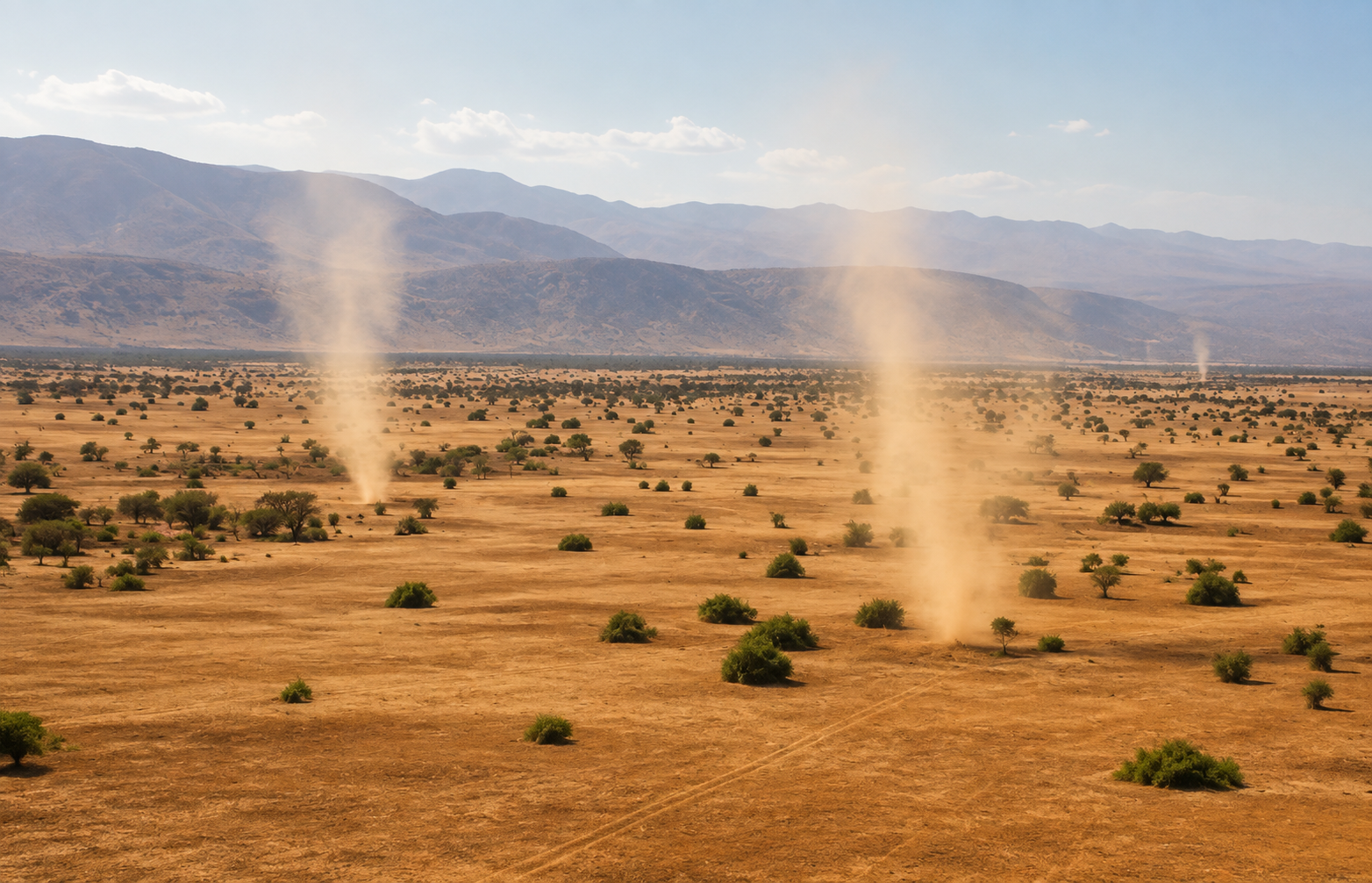
It is precisely this combination of heat, flat terrain, and intense sunlight that creates a phenomenon all its own: the Dalaz, also known locally as “Toz Şeytanı” or “Şeytan Hortumu”—literally, the “dust devil.”
Unlike the waterspouts along the coast, these small whirlwinds do not form from thunderclouds, but rise directly from the ground. When a patch of ground heats up faster than its surroundings, the air there rises abruptly—a small but powerful thermal updraft that sweeps up dust and sand and forms into a visible, spinning column. Usually ten to fifteen meters high, usually lasting only twenty to twenty-five seconds—but impressive enough to make anyone driving through the middle of one for the first time pause for a moment.
Anyone who, like many residents and travelers, regularly crosses the Mesarya has a good chance of driving through one of these dust devils at some point—an experience that is almost as much a part of the interior of Northern Cyprus as the citrus groves of Güzelyurt.
What Science Says About It
Prof. Dr. Murat Türkeş, a climate researcher at Boğaziçi University, places the trend along the coast in a broader context: Over the past twenty years, the frequency of “hortums”—the Turkish umbrella term for tornadoes and waterspouts—in the Mediterranean region and in Turkey has increased by an estimated 50 to 60 percent compared to the previous twenty years.
According to Türkeş, the reason lies not solely in improved observation technology, but in climate change itself: A warmer, more humid atmosphere provides more energy to thunderstorm cells. Systems that used to bring only rain are increasingly developing into supercells—and these can generate tornadoes and waterspouts. Coastal regions with warm ocean surfaces, such as those typical of Northern Cyprus, are particularly affected.
Although the Dalaz whirlwinds of the Mesarya follow a different, purely thermal mechanism that does not involve thunderclouds, they, too, benefit indirectly from the same underlying trend: more hot days, drier soil, and greater temperature differences between the ground surface and the air.
Northern Cyprus Is Also the Focus of Research
Climate studies also warn of this trend for the Turkish Republic of Northern Cyprus itself. A study on water resource management in the TRNC in the context of climate change explicitly identifies dust storms as one of the weather phenomena whose frequency and intensity are expected to increase in the coming years.
In line with this, an international study conducted in the summer of 2026 with the participation of the Cyprus Institute showed that dust events in the eastern Mediterranean are also intensifying due to climate change—particularly in hot, open plains such as the Mesarya.
Context Instead of Alarm
Most waterspouts in the Mediterranean remain exactly what the one off Esentepe was: a brief, impressive natural spectacle over open water that dissipates before it reaches the coast. And the Dalaz whirlpools of the Mesarya are usually over just as quickly as they form—impressive, but generally harmless to anyone who observes them from a safe distance.
Waterspouts become particularly dangerous when they make landfall or catch boats in the immediate vicinity by surprise—which is why it’s important to keep an eye on local weather warnings during transitional periods between seasons, especially for anyone living on the coast or sailing. Inland, the same applies to drivers on the open stretch of the Mesarya Highway: slow down briefly, roll up the windows, and let the waterspout pass.
This is a sign that should be taken seriously, without giving in to alarmism. Northern Cyprus remains what it is: one of the regions of the eastern Mediterranean with a favorable climate—both along the coast and inland.