

Some places tell their stories through their buildings.
In *Salamis*, she tells the story of a man who survived Troy—and was broken by it.
Nestled between pine forests and a deserted beach near Famagusta lie the ruins of a city whose origins lie not in Cyprus, but outside the walls of Troy.
A warrior who left Troy to found a kingdom
Teucer was one of the best archers in the Greek army at Troy.
Son of King Telamon. Cousin of Hector and Paris—and yet their enemy. Half-brother of the great Ajax.
He fought for ten years outside the walls of the city where his own mother was from.
In the end, Troy fell. But Teucer did not return as a hero.
Between Guilt and Exile
When Ajax took his own life, Telamon blamed his son Teucer for failing to protect him.
He was denied a return to Salamis in Greece.
Banished and without a kingdom, Teucer followed a prophecy from Apollo—and sailed east to a beach that is still called the Achaean Coast today.
There, at the northeastern tip of Cyprus, he founded a new city.
And he named it after his lost homeland: Salamis.
The City That Became the Most Powerful on the Island
What began as exile became one of the most significant kingdoms of antiquity.
Beginning in the 11th century B.C., Salamis assumed a leading role among the Cypriot city-kingdoms. From then on, its rulers bore the name Teucrids—descendants of the man who left Troy to build a new kingdom.
Over the centuries, Salamis grew to become the island’s most important port. Copper, trade, wealth. In Roman times, it was the largest city in Cyprus—stretching two kilometers along the coast and reaching deep into the interior.
A city founded out of loss. It grew into a power.
Royal Tombs with a Homeric Ring to Them
A few kilometers from the ruins lies the royal necropolis of Salamis.
Chariots, horse sacrifices, ivory thrones—funeral rites as described in the *Iliad*.
Archaeologists refer to these as Homeric burials. It is as if the kings of Salamis had brought with them from Troy not only the name of their city, but also a reverence for the war that had given rise to it.
It is one of the few places in the world where myth and archaeological discovery are virtually one and the same.
Ruins Among the Pine Trees
Today, Salamis lies quiet.
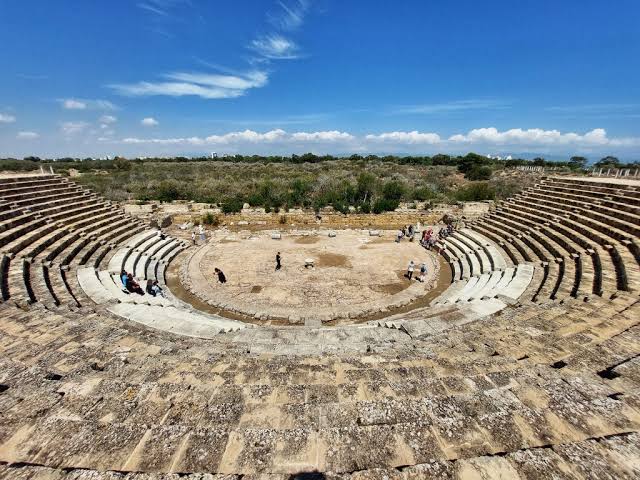
Columns rising from the sand. A Roman theater that once seated thousands. A gymnasium with marble colonnades that cast streaks of late-afternoon light onto the floor.
No ticket booth where people are jostling. No crowd backing up.
Nothing but the wind, the scent of pine trees, and a sea that laps the very same beach where Teucer came ashore over three thousand years ago.
A Legacy That Endures
Salamis is not a footnote in the history of Cyprus. It is its origin.
A city founded by a man who lost everything—and used that experience to create something lasting.
Perhaps that is precisely what gives this place its quiet allure—not what it shows, but what it has endured over the millennia.
Anyone standing between the columns of Salamis is not just standing on Cypriot soil.
But rather at the end of a story that began before Troy.