

Same ground, different chapter.
In the very place where Teucer once founded a kingdom from exile, a man was born centuries later who brought independence to Cyprus in a different way.
His name: Barnabas.
A Son of Salamis
Barnabas was born in Salamis to a Jewish family from the tribe of Levi, which had once migrated from Syria to Cyprus.
Not a general, not a king. A scholar, a mediator, a man of his word.
In Jerusalem, he became one of the leading figures of the early Christian community—and was eventually appointed Archbishop of Salamis.
Companion of Paul
In the year 45 A.D., Barnabas returned to Cyprus. Accompanying him were his cousin John Mark and Paul of Tarsus.
Together, they traveled across the island, from city to city, thereby laying the foundation for what would later become the independent Church of Cyprus.
It was a mission without an army, without power in the traditional sense. Just conviction—and the perseverance to keep moving forward.
Death at the Gates of One's Own City
Around the year 57, this mission came to an end in Salamis itself.
Barnabas was stoned to death by an angry mob; his body was to be burned.
John Mark secretly retrieved the body at night and buried it—with a handwritten copy of the Gospel of Matthew placed on his chest.
A quiet, almost unnoticed end. For more than four hundred years, the exact location of his grave was lost to history.
A Dream That Set the Church Free
In the year 477, Archbishop Anthemios of Cyprus had a vision that led him to a specific spot near Salamis.
There they found the tomb—the body, with the Gospel still resting on its chest.
The discovery was more than just an archaeological find. Emperor Zeno in Constantinople regarded it as proof of the Cypriot Church’s apostolic and independent origins—thereby confirming its independence from the Church of Antioch.
A grave that set an entire institution free.
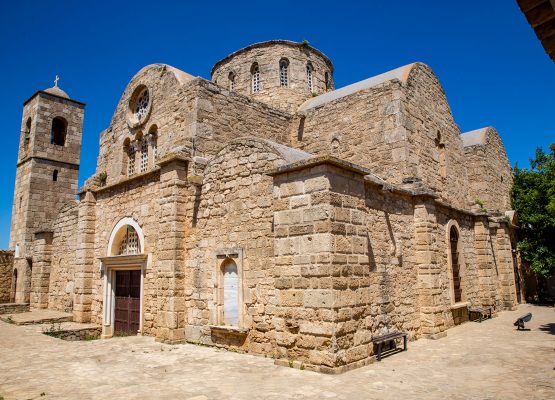
It was right at this spot that Zeno had a basilica built.
Monastery, Icons, Silence
What began in 477 as a church supported by the emperor became a monastery over the centuries; it was destroyed several times and rebuilt several times. The current building dates from 1756.
Monks continued to live here until 1976. Then the last three left the monastery—and a new chapter began: The church became an icon museum, and the monastery buildings were turned into an archaeological collection.
Just a few steps away lie the royal tombs of Salamis. Two forms of eternity, side by side: that of a ruler and that of a saint.
Anyone walking through the quiet courtyards today will find icons, frescoes, artifacts from the Bronze Age—and a sense of peace that has become rare in a place with so much history.
Two Stories, One Floor
Salamis tells a story of war, exile, and rise to power.
Barnabas tells a story of faith, loss, and freedom.
Both stories begin on the same coast—and show that for over three thousand years, this land has drawn people who want to leave behind something lasting.
Some with a sword. Others with a word.
In the end, both leave behind the same thing: a name that has stood the test of time.